Traders Blueprint: running the operation and building the systems behind it
Embedded as the operator of a trading education company, I run sales, marketing and member ops, and I build the systems they run on.
Traders Blueprint is a Dutch trading education company. I work inside it as the operator: I run sales, marketing and member operations, and I build the systems behind them. Funnels and the website, a custom WhatsApp team inbox for setters and closers, exec and marketing dashboards, sales compliance, the member journey, and a full move from Make to n8n.
One operating system for marketing, sales and members, run from the inside: a custom WhatsApp inbox (75 backend functions, 299 commits since June 2026), dashboards for management and marketing, and every Make flow moved to n8n
The problem
Traders Blueprint teaches people to swing trade, next to a job and a family. The business grew fast: paid ads into several funnels, a team of setters and closers on the phone, coaches in Discord, and members buying different programmes.
The tools grew along with it, one at a time. Leads came in through forms, landed in Airtable, got a WhatsApp from somebody's phone, maybe. Automations ran in Make and broke without anyone noticing. Ad spend lived in Meta, calls in Airtable, payments in Stripe, and nobody could answer a simple question like "which funnel actually brings in the people who buy?" without a day of spreadsheet work.
Other problems were about operations. Follow-ups piled up, results weren't filled in, and new members sometimes heard nothing after they paid. Software helps, but somebody has to own it.
So I work inside the company, in the weekly management rhythm, and I build what the operation needs.
What I built
1. The role: running operations and building
Most of my week is operations. I write the weekly update to the sales team, set the rules for follow-ups and bonuses with the sales manager, decide which funnel gets attention, and sit with the team when something isn't working. Then I build the thing that fixes it, usually the same week.
Because I see where the operation leaks, I know what to build. And because I build it myself, it ships fast and fits how the team works.
2. Website and funnels
The website and all funnel pages are hand-built in HTML, CSS and JavaScript on top of the site builder, with one shared script for forms, phone validation, UTM tracking and webhooks. Behind it run four funnels: a free guide, a live masterclass, a free training with a video sales letter and a qualification form, and a trading profile scan.
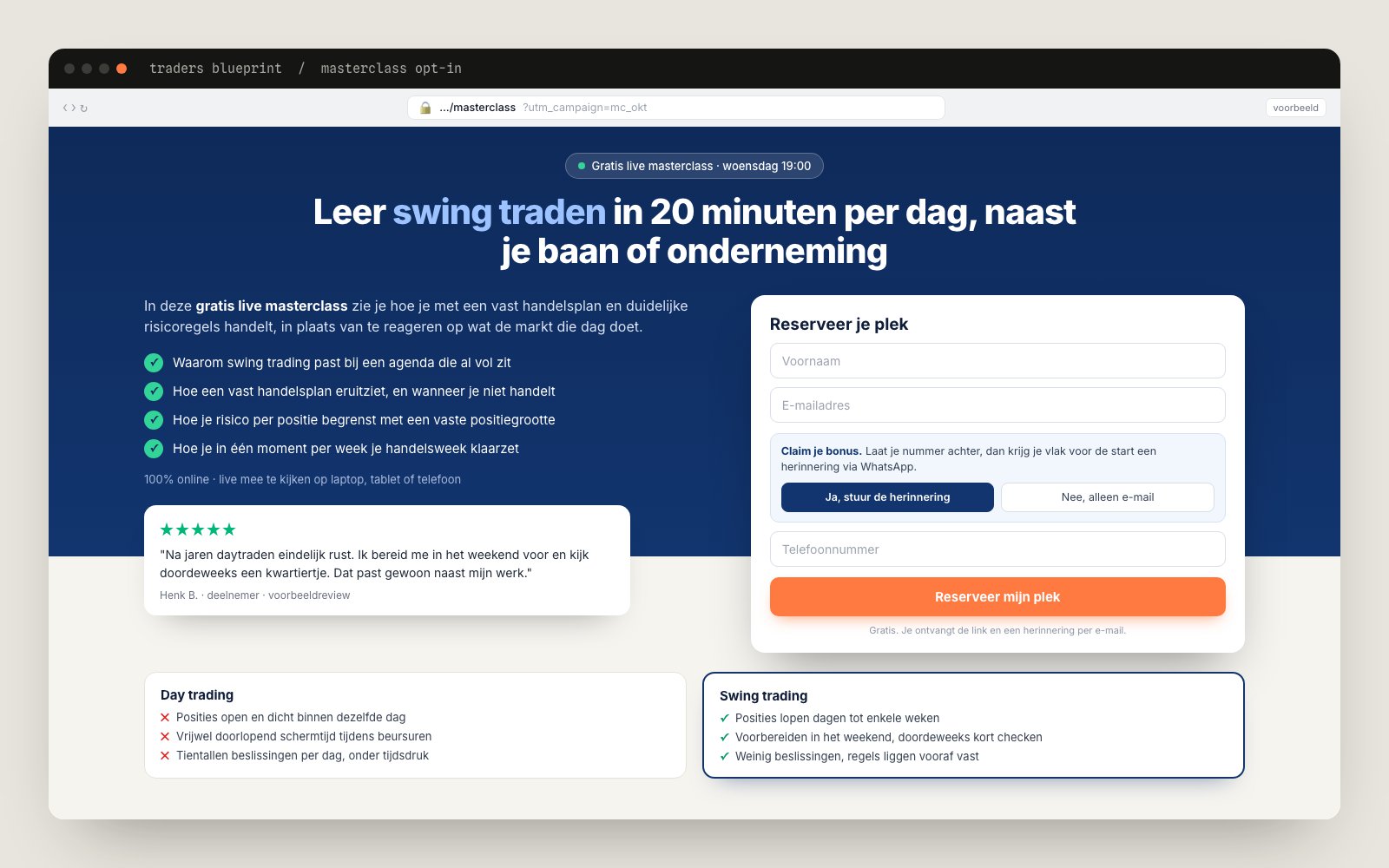
The masterclass is the one I spend most time on. Every edition gets its own cycle: opt-in page, confirmation with an add-to-calendar step, WhatsApp openers and reminders, a nurture mail series to people who haven't signed up yet, attendance tracking, and a different follow-up for people who came, booked, or didn't show. A guard function checks on the morning of every masterclass that everything is scheduled, and checks again at night that every message actually went out.
Funnel pages run split tests inside one URL, so a returning visitor keeps seeing the same version. Tracking is cookieless until consent.
3. A custom WhatsApp team inbox
This is the biggest build. The team worked from personal phones and an off-the-shelf tool. Now every number runs on the official WhatsApp Cloud API, in one React app on Supabase that the whole team uses, on desktop and as an installable phone app.
Shared inbox per role. Setters, closers and the community manager each see their own leads, numbers, templates and saved replies. The database enforces that access.
Assign, label, move. Chats get an owner, tags and a stage on a kanban board. Leads can be handed over between setters, and a closer sees the whole lead, across numbers.
Templates and the 24-hour window. The app knows when you can still type freely and when it has to be an approved template, and helps you write one if it doesn't exist yet.
Automatic openers. A new opt-in gets a first message within minutes, from the right number. When a call is booked, the closer's own number takes over: "I'll call you shortly."
Calling and call notes. Calls go through WhatsApp inside the tool. Recordings are transcribed with Whisper and summarised with Claude, so a manager can read back a call in seconds.
Follow-up and call lists. A daily call list, follow-up dates, internal notes and an end-of-day check.
Payment links. A Stripe payment link with a button straight in the chat, and balance payments that stop the instalment plan automatically when they're paid.
Claude does a few narrow jobs here. It drafts a reply that fits the whole conversation and the CRM, and a person sends it. And before an automatic check-in goes to a member, it reads the conversation and only decides: send or hold. It never writes those messages itself.
4. Member journey
After the purchase is where people quietly drop off, so this got its own flows. A Stripe payment lands as a deal in Airtable, product tags sync to ActiveCampaign so every campaign knows what someone already owns, and course content lives in Kajabi.
New members get a personal welcome from the community manager's own number, a booking link for the welcome call, and then short check-ins at fixed moments after purchase. Nothing goes out while a member is waiting for an answer, or around their welcome call. Of the members who got the first introduction message, 77 percent replied.
Coaching happens in Discord. I built a coach queue that shows which private chats are waiting for a coach and for how long, plus a support list so questions in community channels get an owner instead of scrolling away.
5. Exec and marketing dashboards
Marketing dashboard. A web app with a login per user that pulls ad spend from Meta and Google, attribution from Hyros, forms from Fillout and the CRM from Airtable. Tabs for the overview, the funnel machine, campaign performance, calls and results, setters and closers, and planning.
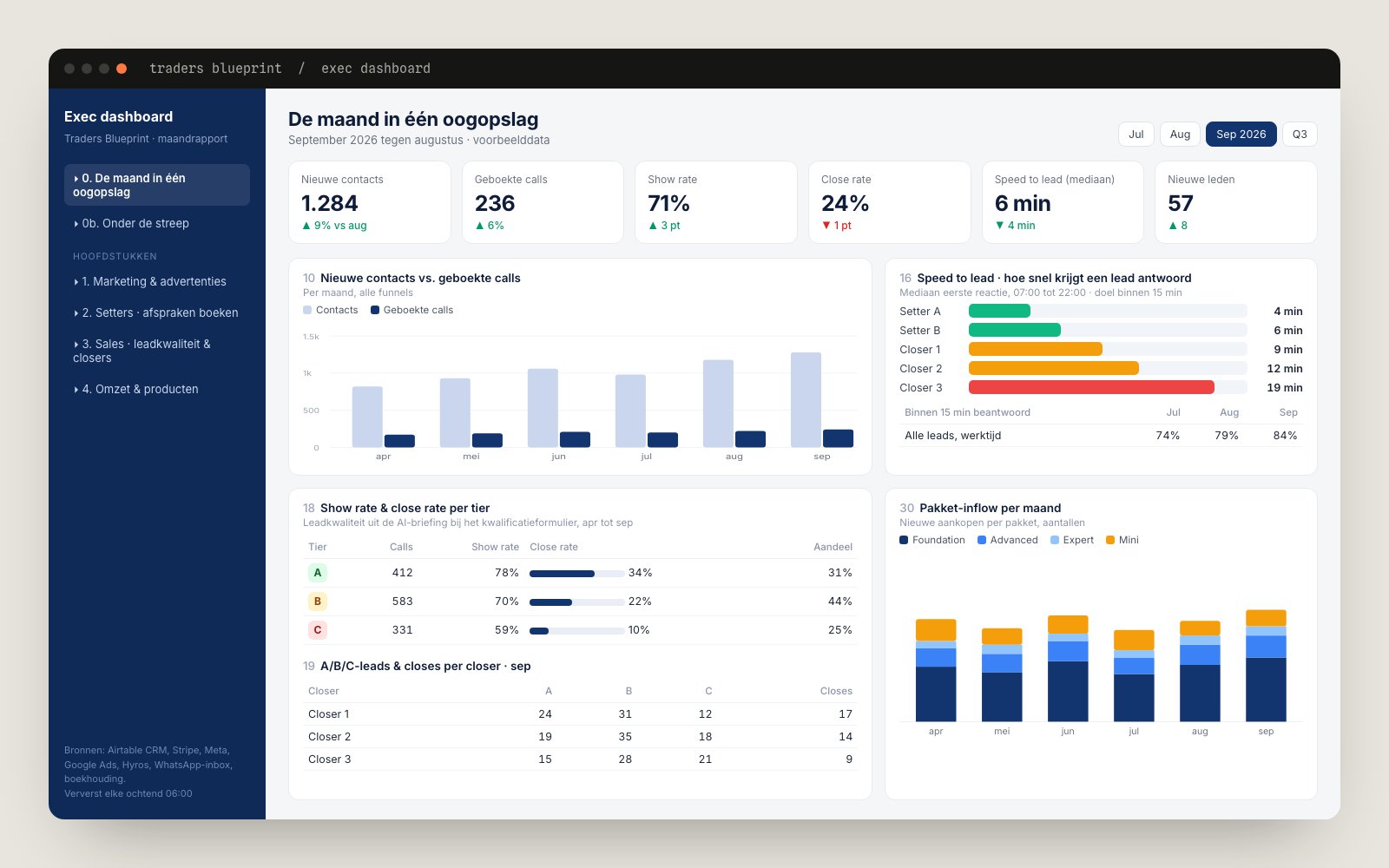
Exec dashboard. A monthly management view on one page: marketing and ads, setter performance and speed to lead, lead quality and closer results, products and instalments, and the numbers from the bookkeeping. It replaced the monthly spreadsheet session.
6. Sales bonus and closer compliance
The sales playbook had rules: start your day, fill in your call results, give a reason for every cancel, check in with a booked lead, clear your follow-ups. Nobody could see who did.
Now a Slack reminder every morning lists each closer's open items. Those reminders feed a compliance sheet per closer per day, and the monthly bonus sheet is generated from the same data: KPIs per closer and setter, month-on-month, with notes for the sales manager. Bonus talks now start from that data.
7. Make to n8n
All automations moved from Make to n8n, self-hosted. The first batch of nine workflows moved in one weekend, together with 77 rebuilt email templates and 18 landing pages wired to the new webhooks. Since then the lead intake, qualification, meeting booked and meeting summary flows run there, with a pass or fail in Slack for every automatic opener. Scheduled jobs in the inbox that break send me a direct message.
8. Video ads and VSL tooling
Ads and the VSL are edited in code, with ffmpeg and Python: captions, b-roll, review proof, end card, both 9:16 and 16:9 from the same footage. Coaching recordings become short clips the same way, with names and usernames hidden. A new hook set takes an evening.
9. How data stays safe
Every user logs in with their own account, and the database decides what each role can see. A setter only sees their own leads and numbers.
WhatsApp media is stored privately, not on public links.
AI drafts or checks; it doesn't send on its own. Templates are written and approved by people.
AI runs through the commercial Claude API, not a consumer chat app, so conversations aren't used to train models.
Analytics are cookieless until a visitor gives consent.
Inside the build
I run operations here and build what the team works in. These are the tools behind it: the team inbox, the dashboards management steers on, and the funnel pieces in front. All names, numbers and messages below are fictitious.
One WhatsApp inbox for sales
Setters, closers and the community manager work from one inbox on the WhatsApp Cloud API. Chats get an owner, tags and a stage, saved replies are one tap away, and an AI draft fits the whole conversation, but a person always presses send.
The month on one page
The management view I built to replace the monthly spreadsheet session: contacts against booked calls, speed to lead per person, show and close rate per lead tier, and new purchases per package.
Every funnel, step by step
The marketing team logs in and sees each funnel from session to show-up, opt-ins per day and results per campaign, pulled together from the ad platforms, attribution, forms and the CRM.
Masterclass opt-in page
One of the funnel pages I build and run. The opt-in feeds n8n, which sends a WhatsApp opener within minutes, and every edition gets its own reminders and follow-up for people who came, booked or missed it.
Closer compliance, from the work itself
A morning Slack reminder lists what each closer still has open. The same data builds a compliance calendar and the monthly bonus sheet, so the bonus talk starts from what was actually done.
The result
One operating system for marketing, sales and members instead of a pile of separate tools
A custom WhatsApp team inbox in daily use by setters, closers and the community manager: 75 backend functions and 299 commits since June 2026
Every Make automation moved to n8n, with alerts when something breaks
Dashboards for management and marketing that replaced manual monthly reporting
Sales compliance and bonuses calculated from the same data the team works in
77 percent of members replied to their first personal message after the new member flow went live
What else you can build when the builder sits inside the operation
The tools here were built for a course business. If your team sells by phone and chat and your data lives in five places, the same building blocks apply:
A team inbox on WhatsApp for sales, support or account managers, with roles, templates and calling.
Speed to lead and follow-up discipline measured automatically, instead of asked about in a meeting.
One management view across ads, CRM, payments and bookkeeping.
Bonus and commission sheets generated from the work itself.
Onboarding and retention flows that react to what a customer did.
What does an embedded operator who builds actually do?
I work inside the company as part of management. I run parts of the operation, like sales follow-up, funnels and member onboarding, and I build the software those parts need myself. That way the person who sees the problem is the person who fixes it.
Can a sales team work from one WhatsApp setup with several numbers?
Yes. With the official WhatsApp Cloud API every number lands in one shared inbox. Each setter or closer sees their own chats, templates and saved replies, and chats can be assigned and handed over.
Can you call through WhatsApp and keep a record of the call?
Yes. Calls can run through the WhatsApp Business Calling API inside the inbox. A recording can be transcribed and summarised, so the next person knows what was said.
Why move from Make to n8n?
For this team: more control, self-hosting and workflows we can keep in code. I rebuilt the flows step by step, with alerts, instead of copying them one to one.
Is our data used to train AI models?
No. AI runs through the commercial Claude API, which doesn't train on your data. It drafts or checks messages and a person stays in control of what goes out.