Using ChatGPT with client data can be done responsibly. Not by promising to be careful, but by building the limits into the software.
October 2026
6 min read
Using ChatGPT with client data can fit GDPR, if you design for it. Use your own business account, connect systems read-only, host the connector in the EU, keep content out of the logs, sign a data processing agreement and let a human approve anything that leaves. Here is how we set that up for Landsman & Teune.
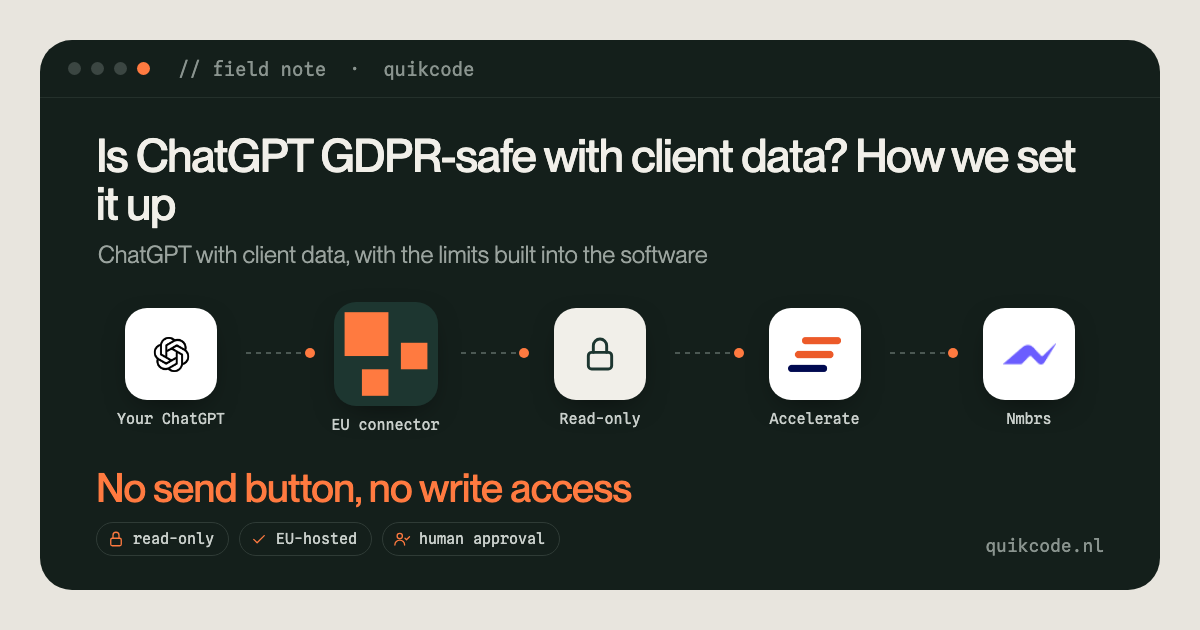
Short answer: yes, you can use ChatGPT with client data in a GDPR-safe way, but only if the safety sits in the setup and not in people's good intentions. For an advice practice or an AI accounting firm setup, that means: your own business account, read-only connections to your systems, EU hosting for anything in between, no client content in logs, a data processing agreement, and a person who approves before anything leaves the building. In Dutch this whole question usually comes in as "is ChatGPT AVG-proof?". Same question, same answer.
One thing first. I'm not a lawyer. This note is about design: what I build, and why. Whether your specific setup is compliant is a question for your privacy officer or legal advisor. What I can tell you is what makes their job a lot easier.
Most firms I talk to are already using ChatGPT with client data. They just don't call it that.
Rein Teune at Landsman & Teune (a mortgage advice practice plus a bookkeeping office in Kampen) is a good example. Before we started, he wrote advice letters like this:
It worked. But every upload was a document full of personal data going in by hand, with nobody deciding what exactly went in, and no record of it.
So the honest starting point isn't "should we allow AI?". It's "it's already happening, so can we make it controlled?". A connector that fetches only what's needed is often safer than a person dragging PDFs into a chat window.
Landsman & Teune works in Accelerate (advice), Nmbrs Accounting (around 246 active client administrations) and a shared Outlook inbox. I built a connector so their own ChatGPT Business can read those three systems. Here is what makes it hold up on privacy, piece by piece.
None of these are clever on their own. Together they mean the rules are enforced by the software. That's the bit I spent the most time on.
Reading is one thing. The moment AI output goes to a client, you want a person in the loop. Not as a policy line, but as a hard gate.
For the advice letters, Rein and ChatGPT had already written their own method and Word template. I built the service around it. ChatGPT prepares the input, the service renders the letter in their template and runs their own checks, and then a person approves it on a separate page.
That approval is tied to a fingerprint of the exact input and the exact document. Change one number and it's a new version that needs a new approval. An approval filled in by the AI gets refused. A letter without amounts is blocked.
The human releases the letter. Never the AI.
The pattern isn't specific to mortgages. It works through MCP, an open standard that ChatGPT, Claude and others support, so you're not locked into one AI vendor.
What firms like this typically connect:
If you want to try this yourself, this is the checklist I'd use:
Honestly, sometimes it isn't.
If you're curious how the full build looks, read the Landsman & Teune case, or browse other work.
And if you're wondering what this would look like with your own systems, grab 30 minutes with me. No pitch, just a look at what you've got.
It can be, if you design for it: a business account where data isn't used for training, a connector that only reads what's needed, EU hosting, no content in logs and a data processing agreement. I'm not a lawyer, so have your privacy advisor check your specific setup. The point is that the limits are enforced by software, not by good intentions.
AVG is simply the Dutch name for GDPR, so the answer is the same. A controlled connector with read-only access and human approval is usually safer than staff uploading PDFs into a chat by hand.
Yes. Accelerate has an API behind the licence, and Nmbrs Accounting has one too. With a connector, ChatGPT Business can search and read dossiers, mortgage details, documents, balances, transactions and the document archive. Nmbrs limits calls per day, so a good connector caches what it can.
Not in the setup we built. It can prepare a draft, but sending and writing are technically impossible because those permissions are never granted. Every advice letter needs a person's approval before it leaves.
Yes. The connector uses MCP, an open standard that ChatGPT, Claude and others support. The privacy rules live in the connector, so they stay the same whichever AI you use.