Automation feels like an asset until all the knowledge sits in one person's head. Why undocumented no-code flows are a hidden risk, and the simple audit that fixes it.
June 2026
4 min read
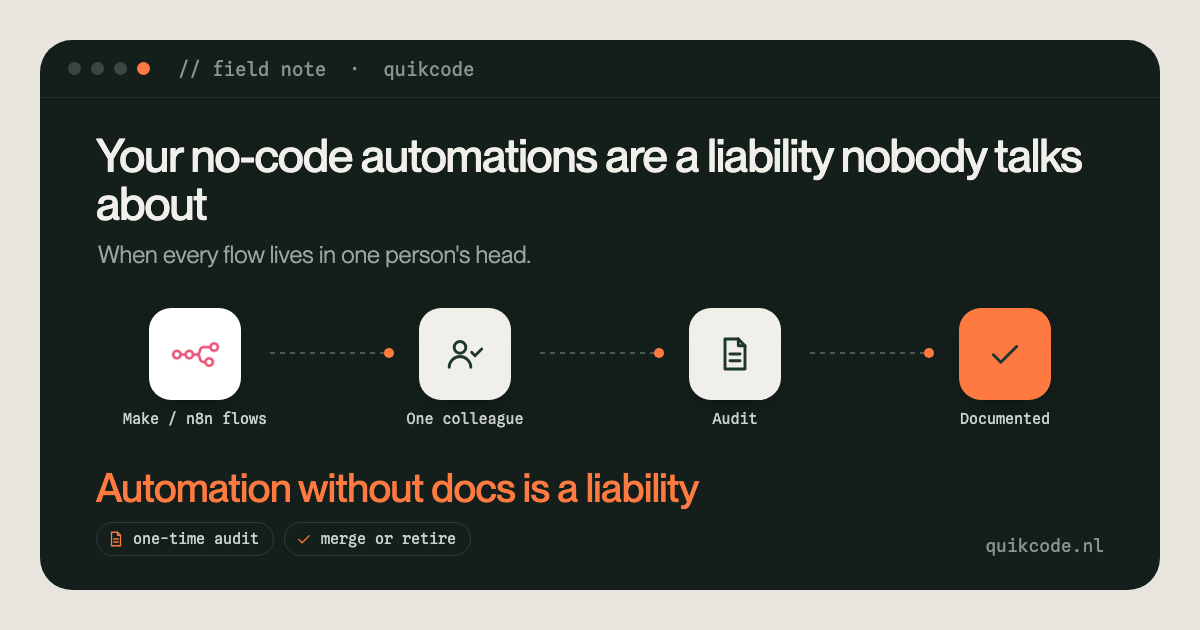
Every automation is also a small debt: it has to be understood and maintained by more than one person. When years of Make or Zapier flows live in one colleague's head, you have a single point of failure. The fix starts with a one-time audit of what runs, what it touches and how fragile it is.
A marketing agency reached out to me last week. Nothing was broken. What worried them was quieter: nobody there fully knew what their own automations did anymore.
They'd been building for years. Smart people, solving real problems as they came up. A flow here to keep a dashboard alive, a flow there for a client process. Make scenarios stacked on Make scenarios. The kind of organic, useful mess that every growing operation produces.
Then someone said the thing out loud: "It mostly lives with one colleague now. What happens when he's sick? Or three weeks on holiday?"
That sentence is the problem. And almost nobody prioritises it until it bites.
I build automation for a living, so I say this with some self-interest: every automation you add is also a small debt. It does work for you, yes. But it also becomes something that has to be understood, maintained, and trusted by more than one person. Most teams only count the first half.
So you get the slow drift I saw at this agency. Multiple people touched the same systems over the years. Each "just quickly fixed" something a slightly different way. Nobody wrote down why. The knowledge didn't disappear. It pooled in the one person who happened to build the most.
That person is now a single point of failure for an operation that thinks it's automated. The automation didn't reduce the risk. It moved it, and hid it.
The line from that call that stuck with me: we don't fully know what's running anymore.
Think about what that means. You can't assess a risk you can't see. You can't hand over a system you can't describe. You can't improve a flow you forgot exists. And you definitely can't tell a client their data is safe if you're not sure which scenario touches it.
Teams underestimate this part. A broken automation announces itself. The real danger is a working automation that only one person understands. It runs perfectly, quietly, right up until that person is unreachable and something needs to change.
When I get asked to fix this, people expect me to rebuild everything. I usually don't. The first job is seeing.
I get admin access to Make, and that's all I need, because from Make I can reach the systems underneath. Then I map the active automations only. Not the dead ones gathering dust, the ones actually running. For each I answer three plain questions: what does it do, in one human sentence? What does it touch, and what touches it? And how fragile is it, how hard would it be for someone else to keep it alive?
That's it. A one-time report, not a live dashboard, because nobody needs to watch it forever. The goal is to turn "it's all in one person's head" into "it's written down, and anyone competent could pick it up." And the same document that de-risks the operation usually exposes three or four automations you can merge, retire, or move somewhere cheaper. So the audit usually pays for itself.
Automation without documentation is a liability wearing an asset's clothes.
If exactly one person at your company can explain how your automations work, you have a dependency with a nice dashboard on top. More tools won't fix that. Making the work legible to more than one human will.
So a small, blunt test. Pick your most important automated process and ask: if the person who built this vanished tomorrow, how long until we're in trouble? If the answer is "fast", you have a continuity problem, and it's worth solving now.
Because a working automation that only one person understands fails silently the day that person is unavailable. You cannot assess, hand over or improve what you cannot see.
Map only the active scenarios and answer three questions for each: what does it do, what does it touch and what touches it, and how fragile is it. The result is a one-time report anyone competent can pick up.
Not by default. Most of the time documenting, merging and retiring flows is enough. Rebuild only the parts that are fragile and business-critical.